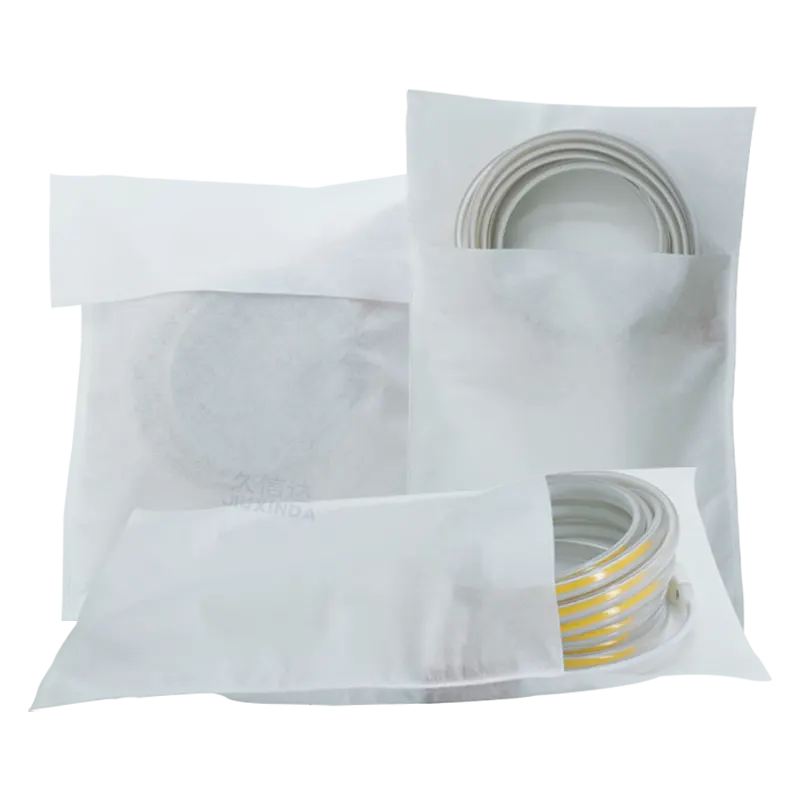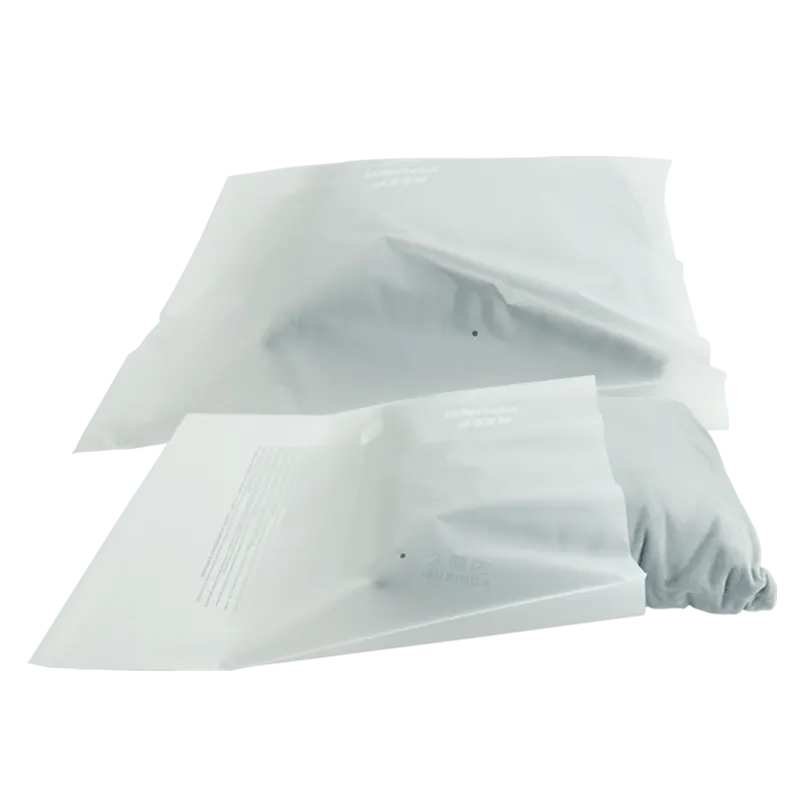
Recycled PE bags are moving from a sustainability option to a purchasing requirement. The EU Packaging and Packaging Waste Regulation (PPWR), retailer packaging rules, and brand-level recycled-content targets are all pushing buyers to replace virgin plastic where the application allows it. But a certificate PDF by itself does not prove what is in the bags delivered to your warehouse. If the supplier cannot connect its certification, material records, and shipment documents, your recycled-content claim may be impossible to defend.
The seven checks below are designed for packaging buyers, sourcing teams, and sustainability managers. Use them before approving a supplier, then run the eight-point checklist at the end before placing the first production order.
1. Verify GRS certification — and the TC that backs your order
Start with the supplier's Scope Certificate, usually called an SC. Check the legal company name, site address, certification body, validity dates, approved processes, materials, and product categories. Do not accept a certificate issued to a related trading company if a different factory will make your bags.
Use Textile Exchange's Find a Certified Company database rather than relying on the PDF sent by a salesperson. Textile Exchange describes the database as a central source using current Scope Certificate data supplied by active certification bodies. If the record is missing, expired, or inconsistent, contact the named c
ertification body before moving forward.
Next, confirm that the scope covers the work required for the finished PE bag. A resin trader, film extruder, printer, and bag converter perform different certified activities. The supplier should be able to show how the certified chain reaches the final converted bag.
Then ask a more practical question: Can this order be supported by a Transaction Certificate, or TC? Under the Global Recycled Standard, pre-consumer and post-consumer content are recorded separately by batch and included in transaction records. Ask for a redacted TC from a previous shipment so your compliance team can see the document format, seller, product description, material percentages, shipment dates, and certification body.
Red flag: the supplier repeatedly sends the same Scope Certificate but cannot explain the TC process, provide a redacted example, or confirm that your order is eligible.
2. Confirm PCR content and traceability
"Contains recycled material" is not a specification. Your purchase agreement should state the target post-consumer recycled (PCR) percentage, whether any pre-consumer material is included, the permitted tolerance, and the calculation basis. Keep virgin PE and additives listed separately.
Request three things before approving the film:
A technical data sheet for the proposed formulation.
A physical sample made at the requested thickness and PCR level.
Batch-level traceability documents linking the recycled input, production lot, and finished bags.
The sample matters because PCR content can affect haze, color, odor, tensile performance, sealing behavior, and print appearance. A higher percentage is not automatically better if the bag splits during packing or no longer protects the product. Test the actual structure you intend to buy, not a clear virgin-PE sample described as "equivalent."
Include the claim in the contract as well. For example: "Bag film contains 30% post-consumer recycled PE by weight, supported by applicable GRS transaction documentation." Your legal or sustainability team should approve the final wording for the destination market.
Red flag: the recycled percentage appears only in an email or quotation, while the TDS, sample label, purchase contract, and shipping documents say nothing about it.
3. Separate recycled, recyclable, and compostable claims
These terms answer different questions:
Recycled describes where some of the material came from.
Recyclable describes whether the finished package can be collected, sorted, and reprocessed in the market where it is sold.
Compostable describes performance under specified composting conditions and normally requires a separate material system and certification route.
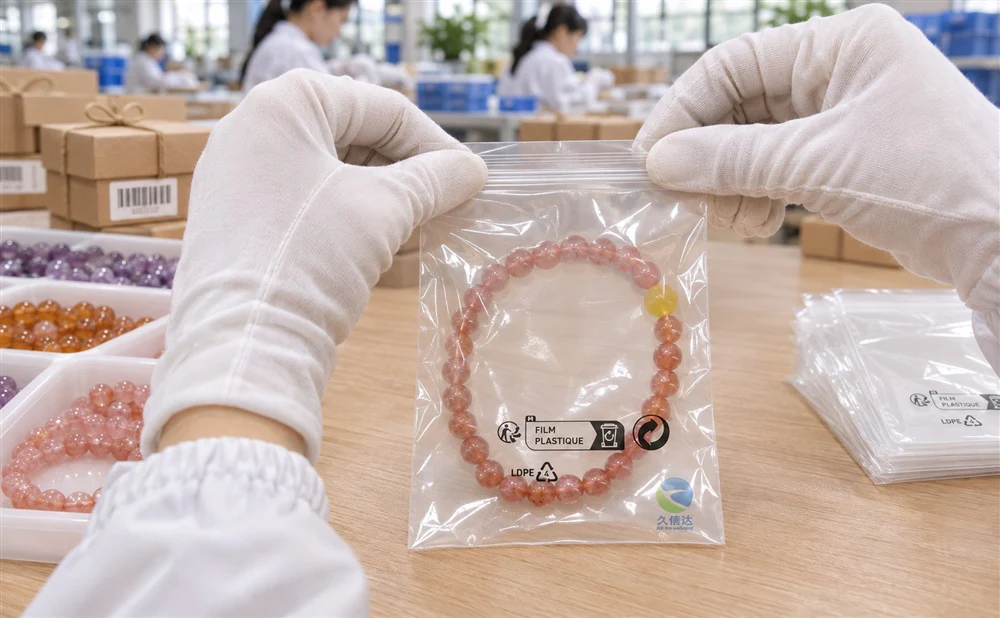
A recycled PE bag may be recyclable, but recycled content alone does not prove recyclability. A mono-material PE structure usually gives designers a better starting point than a multilayer structure with incompatible barriers, labels, inks, or zippers. Actual eligibility still depends on the complete package and the local collection system.
In the United States, review the FTC Green Guides before using environmental claims. The Guides apply to business-to-business claims as well as consumer marketing. For flexible PE packaging, How2Recycle assesses the submitted packaging specifications and may assign labels such as Store Drop-off, Check Locally, or Not Yet Recyclable. A resin identification code is not, by itself, a recycling instruction.
For the EU, align the design and evidence package with Regulation (EU) 2025/40. The PPWR has applied since 12 August 2026 and introduces recyclability and recycled-content requirements on staged timelines. It does not turn a GRS Scope Certificate into an EU market-approval document.
Avoid broad claims such as "biodegradable plastic" unless you can name the standard, disposal environment, certification status, and geographic relevance. Recycled PE and compostable film are separate purchasing paths.
Red flag: a supplier uses recycled, recyclable, biodegradable, and compostable as if the words were interchangeable.
4. Check whether the supplier actually owns the factory
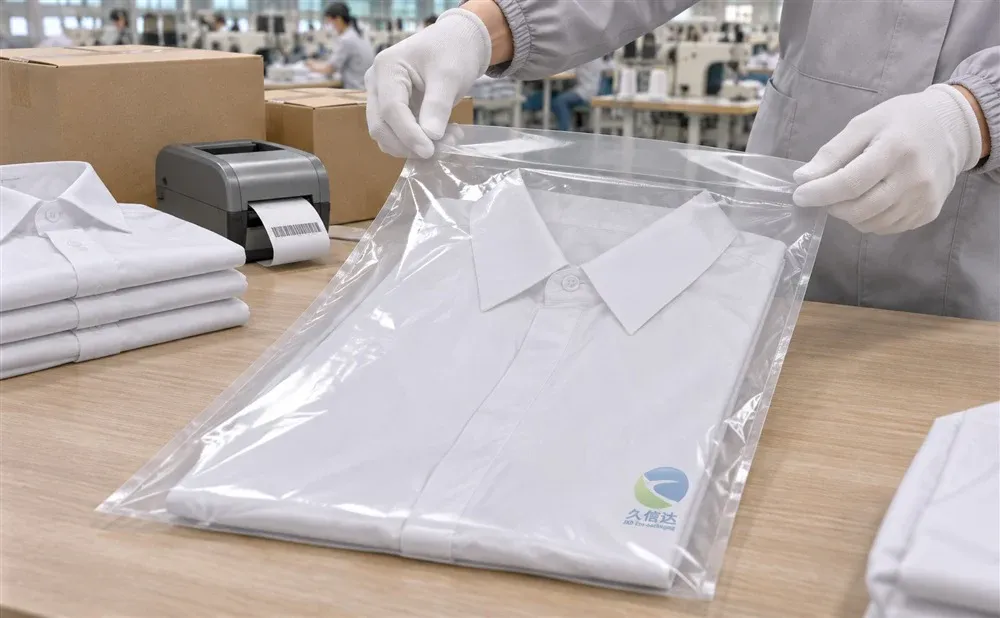
A polished website cannot tell you who extrudes the film or converts the bags. Ask for the legal name and address of each manufacturing site, then compare them with the business licence, Scope Certificate, audit reports, invoices, and shipping documents.
For a video audit, do not settle for a conference-room presentation. Ask the supplier to walk from raw-material storage to film extrusion, printing, bag conversion, inspection, packing, and the finished-goods area in one continuous call. Request close views of machine nameplates, work orders, production boards, incoming material labels, and lot identification.
BSCI or Sedex/SMETA reports can help corroborate that a named site was audited. They do not prove ownership on their own. Sedex explains that a SMETA audit is an on-site assessment of an individual worksite's labour, health and safety, environmental, and business-ethics practices. Use it as one part of the evidence set, not as a substitute for a factory audit.
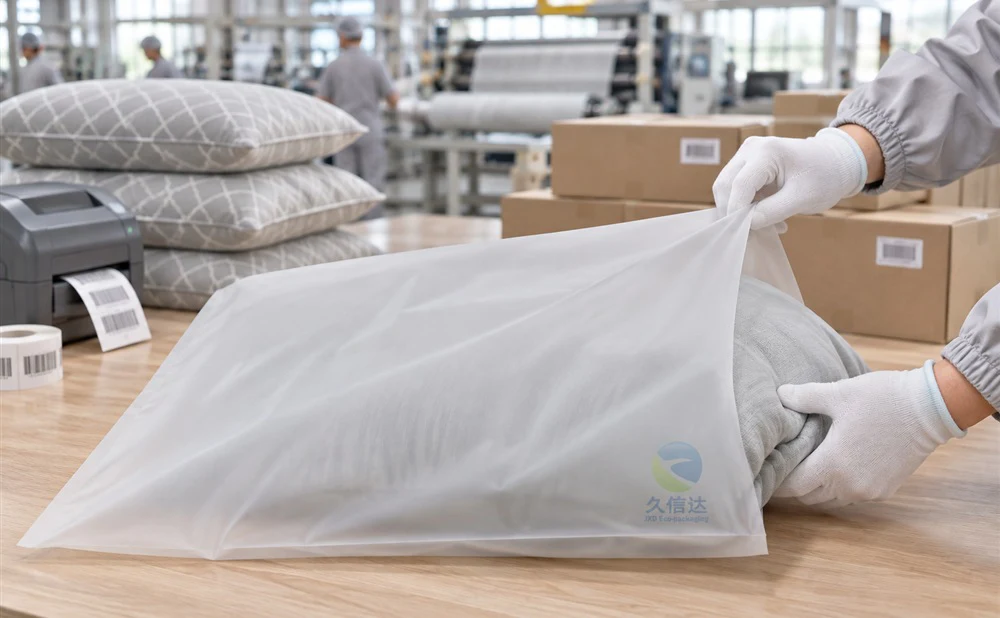
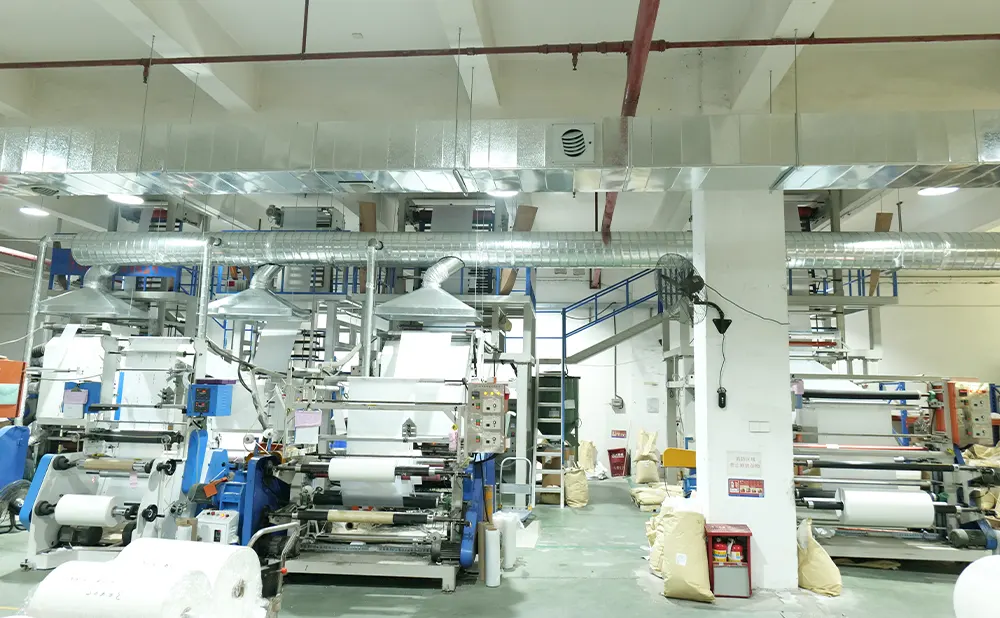
JXD Eco-Packaging's factory setup provides a useful comparison point. According to its company documentation, JXD Eco-Packaging operates production bases in Shenzhen and Dongguan, runs 34 automated production machines, and has annual capacity above 2,000 tonnes. Its process coverage includes film production, printing, and bag conversion. Those numbers should still be checked against the current audit pack and the site handling your order.
Red flag: the supplier will show finished bags but avoids live footage of extrusion, printing, or bag-making, or the production address changes between documents.
5. Assess quality control and batch-to-batch consistency
The first sample proves that a bag can be made. It does not prove that the 20th production batch will match it.
Ask the manufacturer to define inspection methods and acceptance limits for:
film thickness and thickness variation;
dimensions and opening direction;
tensile strength and elongation;
tear or impact resistance where relevant;
side-seal or bottom-seal strength;
zipper, adhesive strip, or closure performance;
haze, color difference, odor, and visible contamination;
print position, color, adhesion, and barcode readability.
The approved sample should become a signed master sample. Your purchase order should reference the drawing, material formulation, PCR percentage, film gauge, print artwork, closure, packing method, and inspection standard. For the first order, use a pilot quantity that is large enough to run on normal production equipment. A hand-made sample or laboratory roll may behave differently from mass production.
Ask for a production inspection report and retain samples from each shipment. If a later batch fails, those records make root-cause analysis much faster.
Red flag: the supplier says quality is "standard" but cannot provide numeric tolerances, test records, or a written control plan.
6. Test customization, sampling speed, and MOQ fit
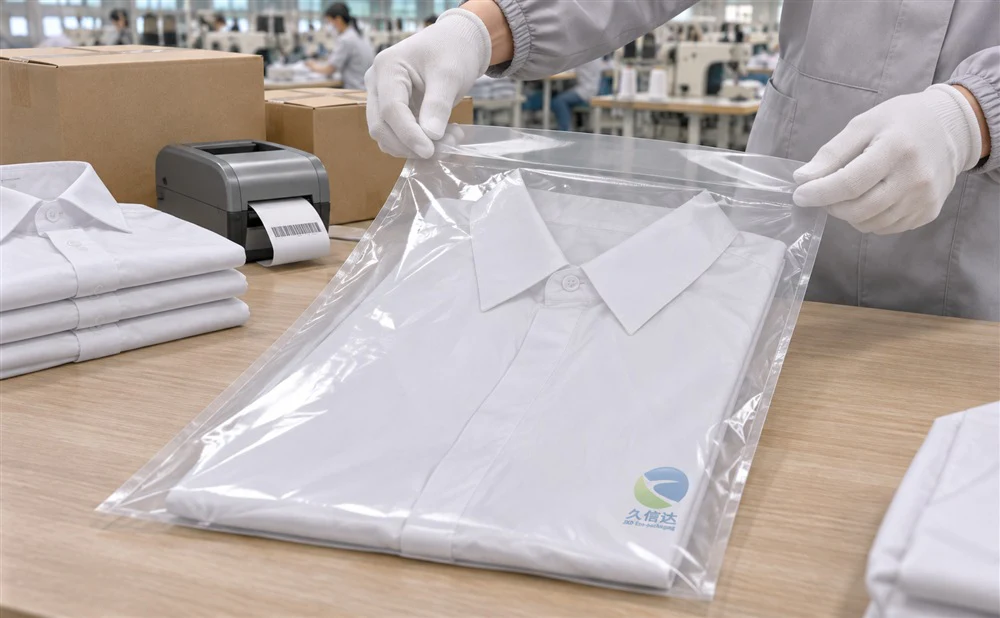
A capable recycled PE bag manufacturer should be able to discuss more than length and width. Depending on the application, you may need a specific film gauge, PCR percentage, print coverage, ventilation holes, anti-static performance, adhesive flap, zipper profile, hanger opening, warning print, or pack-out method.
Ask for the MOQ by bag structure, not one company-wide number. An unprinted flat bag, a printed self-seal garment bag, a large frosted CPE bag, and a small reclosable jewelry bag do not have the same setup loss or production economics. Also ask whether the quoted MOQ is based on pieces, kilograms, or one full production roll.
Sampling speed is a useful test of internal coordination. JXD Eco-Packaging quotes sampling by bag type, with a working target of about 24 hours for standard samples and one to two days for straightforward custom samples after specifications and artwork are confirmed. Complex printing, unusual PCR levels, new tooling, or third-party testing will take longer. Put the promised date and sample specification in writing.
When comparing suppliers, record four separate figures: sample cost, sample lead time, MOQ, and mass-production lead time. A low MOQ is not helpful if the supplier needs six weeks to repeat the order.
Red flag: the supplier promises every sample in 24 hours without first confirming the resin, thickness, printing method, closure, and testing requirements.
7. Review the compliance package for your destination market
There is no universal "compliance certificate pack" for every recycled PE bag. Build the file around the country, packed product, sales channel, and environmental claim.
For an EU-bound non-food garment bag, the file may include the valid GRS Scope Certificate, applicable TC or eTransaction evidence, material composition, recycled-content records, REACH-related substance information, packaging specifications, test reports, and the technical documentation needed by the responsible economic operator under the PPWR. Do not ask for a generic "PPWR certificate"; the regulation places documentation and conformity duties on economic operators and is supported by implementing and delegated rules.
RoHS is mainly an electrical and electronic equipment substance-restriction regime, not a blanket certification requirement for every PE bag. It may still appear in a customer's specification for electronics packaging, but buyers should state why it applies. Food contact, medical, children's products, cosmetics, and hazardous goods require additional review.
Social-compliance evidence such as BSCI or SMETA serves a different purpose from product testing. Keep the files separate so a social audit is not presented as proof of recycled content or chemical compliance.
The real cost of using several loosely connected suppliers is not just the price difference. It is the time spent reconciling material declarations, test reports, audit addresses, TCs, artwork records, and shipment documents after the order has already left the factory.3
Why JXD Eco-Packaging is worth adding to the shortlist
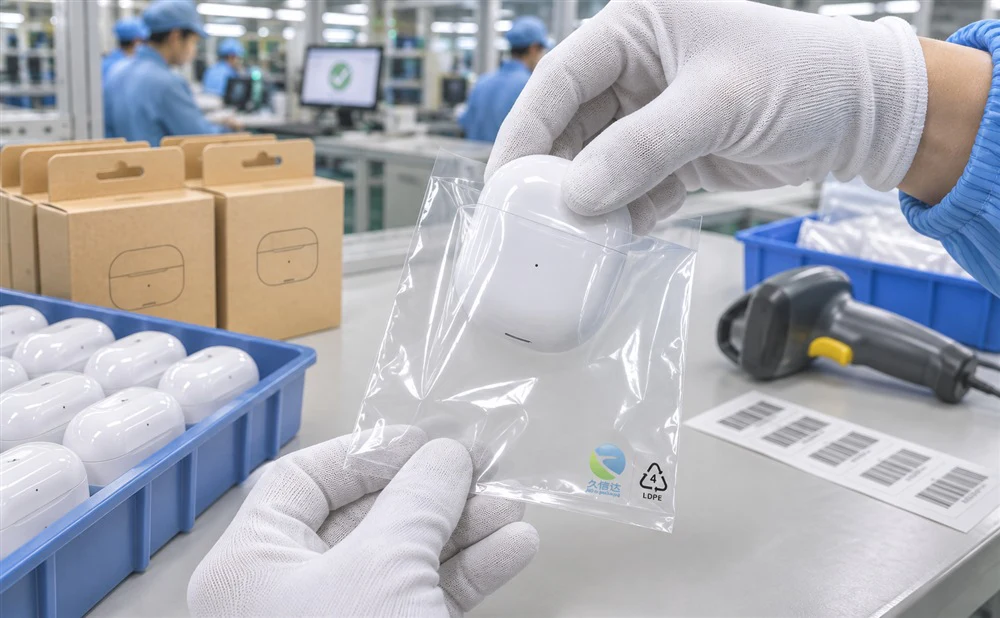
JXD Eco-packaging combines recycled-material documentation with direct manufacturing control. The company manages key processes including film production, printing, bag converting, inspection, and packing. This gives buyers a clearer route from sample approval to repeat production while reducing the uncertainty created by outsourced manufacturing.
Key reasons to consider JXD Eco-packaging include:
GRS documentation support
Buyers can request the current GRS Scope Certificate and discuss TC or eTransaction support for eligible orders. Document availability should be confirmed before the purchase order is signed.In-house production control
Film production, printing, and bag converting are managed within JXD Eco-packaging’s production system, making it easier to control materials, specifications, lead times, and batch consistency.Scalable manufacturing capacity
Dual production bases and automated equipment support both trial orders and repeat bulk production, reducing reliance on external subcontractors.Flexible recycled PE bag customization
PCR percentage, bag dimensions, film thickness, printing, ventilation holes, adhesive flaps, zipper closures, and packing methods can be developed around the product.Sampling and trial-order support
Buyers can test the proposed material and bag structure before committing to mass production. Sampling time and MOQ are confirmed according to the bag type and customization requirements.Destination-market document review
JXD Eco-packaging can help organize applicable GRS, material, test, and social-compliance documents. Final requirements are checked against the packed product, destination country, and intended environmental claims.A controlled path from sample to repeat order
Approved specifications, artwork, samples, and inspection requirements can be retained as references, helping later production batches remain consistent.
JXD Eco-packaging is worth considering when a project requires traceable recycled material, customizable PE bag structures, direct factory control, and practical support from sampling through repeat supply.
Eight-point buyer's checklist
Before approving a GRS-certified recycled PE bag manufacturer, confirm all eight items:
Scope Certificate: The legal name, site, validity, processes, materials, and product scope match the proposed producer and finished bag.
Transaction evidence: The supplier can explain TC or eTransaction eligibility and provide a redacted example before the purchase order is signed.
PCR specification: The contract states the post-consumer percentage, any pre-consumer content, tolerance, and calculation basis.
Claim accuracy: Recycled, recyclable, and compostable claims are kept separate and matched to the destination market.
Factory verification: The production site, machinery, process ownership, and subcontracting arrangements have been checked by video or on-site audit.
Quality controls: The approved sample, numeric tolerances, test methods, inspection plan, and batch records are documented.
Commercial fit: MOQ, sample lead time, production lead time, tooling, print cost, and repeat-order terms suit the purchasing plan.
Market documents: The compliance file is built for the destination country and product use, with no unsupported "green" or regulatory claim.
The right supplier is not the one with the longest certificate list. It is the one that can connect a valid certificate to traceable material, owned or controlled production, repeatable quality, and documents your market can actually use.
Start with a production-representative sample. Follow it with a controlled trial order. Move to a long-term agreement only after the bulk shipment matches the approved specification and the promised traceability documents arrive on time.
Get GRS certificate copies, a TC sample, and a free bag sample from JXD Eco-Packaging. Share the bag size, thickness, target PCR percentage, printing artwork, packed product, annual volume, and destination market to receive a specification-based quotation.
BUYER QUESTIONS
Questions before requesting a quotation
Is GRS certification enough for selling recycled PE bags in the EU?
No. GRS is a voluntary chain-of-custody and processing standard. It can support a recycled-content claim, but it does not replace PPWR technical documentation, REACH-related substance obligations, product-specific safety rules, labelling requirements, or the duties of the manufacturer and importer. Build the compliance file around the exact packaging and market.
What is the difference between PCR content and a recyclable bag?
PCR content tells you how much post-consumer recycled material is in the bag. Recyclability concerns the design of the complete package and whether it can be collected, sorted, and reprocessed in the destination market. A bag can contain PCR and still be difficult to recycle because of incompatible layers, attachments, inks, labels, or local infrastructure.
What is a typical MOQ for custom recycled PE bags?
There is no reliable universal figure. MOQ changes with bag size, thickness, PCR percentage, print colors and coverage, closure type, and whether the order can share a standard film run. Ask for the MOQ in both pieces and kilograms, and request separate figures for unprinted samples, printed trials, and mass production.
How can I verify a GRS certificate online?
Search the legal company name or certificate details in Textile Exchange's Find a Certified Company database. Compare the site address, validity period, product scope, materials, and processes with the quotation. If anything is unclear, contact the certification body shown on the Scope Certificate.
Can recycled PE bags be custom printed?
Yes. Recycled PE bags can be printed, but PCR level, base-film color, haze, surface treatment, ink system, and print coverage affect the result. Approve the artwork on a production-representative sample and set tolerances for color, registration, adhesion, and barcode readability.
How long does sampling take?
Stock or standard-structure samples may be available within 24 hours. A straightforward custom sample may take one to two days after the specification and artwork are confirmed. New resin blends, high print coverage, tooling, or third-party testing can extend the schedule. Treat any lead time as a written project commitment, not a generic website promise.